
What is the difference between Ceylon and cassia cinnamon?
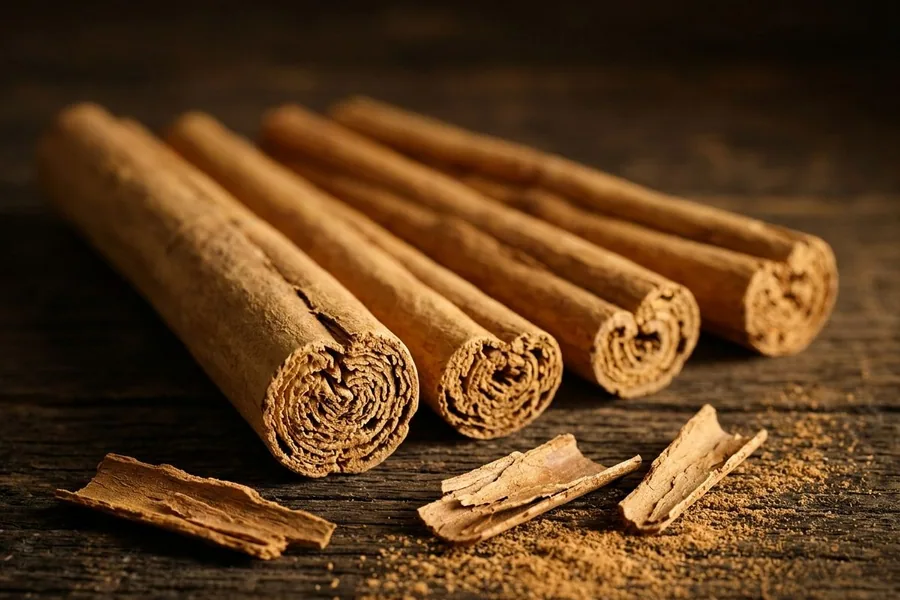
Ceylon cinnamon is the inner bark of Cinnamomum verum, rolled into thin quills of many papery layers: light tan, brittle and mild. Cassia comes from related trees, mainly in China, Indonesia and Vietnam: one thick layer of darker, harder bark with a stronger flavour. Cassia also holds far more coumarin, about 3,000 mg per kg on average (BfR).
| Feature | Ceylon cinnamon | Cassia |
|---|---|---|
| Botanical name | Cinnamomum verum (also Cinnamomum zeylanicum) | Cinnamomum cassia (Chinese), Cinnamomum burmanni (Indonesian), Cinnamomum loureiroi (Vietnamese) |
| Main origin | Sri Lanka | China, Indonesia and Vietnam |
| Bark | Thin inner bark, many fine layers rolled into one quill | One thick layer of bark, curled into a hollow roll |
| End of a stick | Looks like a cut cigar, packed with layers | A single curl, open in the middle |
| Colour | Light tan to golden brown | Darker reddish brown |
| Texture | Brittle, crumbles in the hand | Hard and woody |
| Flavour | Mild, sweet and delicate | Strong, hot and pungent |
| Coumarin | Low | About 3,000 mg per kg on average, up to 10,000 mg per kg |
| Standard | ISO 6539; graded in Sri Lanka under SLS 81 | ISO 6538 |
Coumarin levels from the BfR; the types and standards from ISO 6539 and ISO 6538. See the sources at the end of this guide.
Cinnamomum verum vs cassia: two different trees
Ceylon cinnamon, also called true cinnamon, is the dried inner bark of Cinnamomum verum, a tree native to Sri Lanka. Cassia is the bark of related trees: Chinese cassia (Cinnamomum cassia), often sold as Chinese cinnamon, Indonesian cassia (Cinnamomum burmanni) and Vietnamese cassia (Cinnamomum loureiroi).
The international standards keep them apart. ISO 6539 covers cinnamon of the Sri Lankan, Madagascan and Seychelles types, and ISO 6538 covers the three types of cassia. Sri Lanka grows true cinnamon, while China, Indonesia and Vietnam produce cassia in large quantities (IPS).
How to tell Ceylon and cassia apart
Look at the end of a stick. Ceylon cinnamon is rolled from many thin sheets of inner bark, so its cut end looks like a cut cigar, packed with fine layers. Cassia is one thick layer of bark that curls into a hollow roll (BfR).
Ceylon quills are lighter in colour and crumble in the hand. Cassia sticks are darker and harder, and difficult to snap.
Ground, the two are hard to tell apart by eye (BfR). Ask the supplier for the botanical name and the origin, and test a sample before you order. The guide to how to verify true Ceylon cinnamon explains the checks.
How much coumarin is in cassia compared with Ceylon cinnamon?
Cassia contains far more coumarin than Ceylon cinnamon. Germany's Federal Institute for Risk Assessment (BfR) reports that cassia contains about 3,000 mg of coumarin per kg on average, with the highest measured levels around 10,000 mg per kg, while Ceylon cinnamon contains only low levels.
The numbers matter to food makers because the EU limits coumarin in finished foods. Regulation (EC) No 1334/2008 on flavourings sets these maximum levels, and the UK applies the same levels under its retained version of the regulation:
| Food | Maximum coumarin |
|---|---|
| Traditional and seasonal bakery ware that mentions cinnamon on the label | 50 mg per kg |
| Breakfast cereals, including muesli | 20 mg per kg |
| Other fine bakery ware | 15 mg per kg |
| Desserts | 5 mg per kg |
The limits apply to the food, not to cinnamon sold as a spice, which has no coumarin limit (BfR). The guide to coumarin in Ceylon cinnamon covers the levels and the limits in more detail.
How Ceylon cinnamon is graded and priced
In Sri Lanka, Ceylon cinnamon is graded under SLS 81, the Sri Lanka Standards Institution's specification for Ceylon cinnamon. Quills are graded by their diameter, the number of whole quills per kilogram and the extent of foxing, the reddish-brown patches on the bark (IPS). The thinnest quills are Alba; thicker quills fall into the Continental, Mexican and Hamburg grades.
The price of Ceylon cinnamon depends on the grade, the form and the quantity, so Harvest Gate quotes each consignment separately, with the grade, form and packing set out in the quotation. The guides to Ceylon cinnamon grades and what sets the price go further.
Which cinnamon should importers buy?
Buy the one your product and your market call for. Choose Ceylon cinnamon when the label must say Ceylon or true cinnamon, or when a mild, sweet flavour suits the recipe. It also helps bakery, cereal and dessert makers stay within the EU and UK coumarin limits. Cassia suits recipes that need a strong, hot flavour, as long as the finished food stays within those limits.
Harvest Gate is an agricultural exporter based in Colombo, Sri Lanka. It exports Ceylon cinnamon as quills and powder. Quillings, chips and cinnamon oil are in its range ofSri Lankan spices too. Request samples to compare them with the cinnamon you buy now.
Buyer questions
Questions buyers ask about Ceylon and cassia cinnamon
What importers and food makers ask when choosing between Ceylon cinnamon and cassia. Not answered here? Send the question with your sample request.
Request samples01Is Ceylon cinnamon better than cassia?
Neither is better for every use. Ceylon cinnamon has a milder, sweeter flavour and only low levels of coumarin, which suits food makers working to the EU and UK coumarin limits. Cassia has a stronger, hotter flavour and far more coumarin. Choose by the recipe, the label and the market you sell to.
02What is the difference between cassia and Ceylon cinnamon?
In the hand, Ceylon cinnamon is a light, brittle quill of many thin layers, and cassia a dark, hard roll of one thick layer. In a recipe, Ceylon cinnamon is mild and sweet, and cassia strong and hot. In the laboratory, cassia holds about 3,000 mg of coumarin per kg on average, and Ceylon cinnamon only low levels.
03What is Ceylon cinnamon vs cinnamon?
"Cinnamon" on a label can mean either Ceylon cinnamon or cassia. Ceylon cinnamon, also called true cinnamon, is the bark of Cinnamomum verum from Sri Lanka. Ground cassia and ground Ceylon cinnamon are hard to tell apart by eye, so a pack that says only "cinnamon" may hold cassia; packs of Ceylon cinnamon usually name it.
04Can I get samples of Ceylon cinnamon from Sri Lanka?
Yes. Request samples with your delivery address and the form you are interested in, such as quills or powder, so you can compare them with the cinnamon you use now before your first order.
Sources
- BfR, Germany's Federal Institute for Risk Assessment: FAQ on coumarin in cinnamon and other foods.
- European Union: Regulation (EC) No 1334/2008 on flavourings, Annex III. The UK's retained version: Regulation (EC) No 1334/2008, Annex III.
- ISO: ISO 6539:2014, Cinnamon (Cinnamomum zeylanicum Blume), specification, which refers to ISO 6538 for cassia.
- IPS, the Institute of Policy Studies of Sri Lanka: Quality standards: make or break point of Sri Lanka's cinnamon industry (Daily Mirror, 14 May 2019).
Request samples
Compare Ceylon cinnamon with the cinnamon you use now.
Tell us the form you are interested in, such as quills or powder, and where to send the samples.