What is true Ceylon cinnamon?
True Ceylon cinnamon is the dried inner bark of Cinnamomum verum (also Cinnamomum zeylanicum), a tree native to Sri Lanka. Peelers scrape off the outer skin, loosen the bark with a brass rod and roll the pieces into quills, which are dried indoors (DEA). Its flavour is mild and sweet, and it contains only low levels of coumarin (BfR).
Where is Ceylon cinnamon grown?
Cinnamon first grew wild in the central hill country of Sri Lanka. Today its commercial cultivation is concentrated along the coastal belt from Negombo to Matara, and has spread inland to Kalutara and Ratnapura. It is also grown in the intermediate zones of the mid and low country (DEA).
The name is protected too. Since February 2022 "Ceylon cinnamon" has been a protected geographical indication (PGI) in the EU, under Commission Implementing Regulation (EU) 2022/144. The Export Development Board of Sri Lanka (EDB) licenses the Ceylon Cinnamon PGI mark for quills, powder, leaf oil and bark oil that are grown, processed and manufactured in Sri Lanka (EDB).
How Ceylon cinnamon is made
Ceylon cinnamon is peeled by hand, skilled work passed down through generations (IPS). The Department of Export Agriculture describes the steps (DEA):
- The outer skin of the cut stem is scraped off.
- The bark is loosened from the wood with a brass rod and peeled off part by part with a special knife.
- The pieces of bark are rolled and joined into a long, pipe-like quill, and the hollow is filled with small pieces of bark.
- The quills are dried indoors for about 4 to 7 days.
The smaller pieces are sold as quillings, featherings and chips, and essential oils are distilled from both the bark and the leaves (DEA). The guide to harvesting and processing Ceylon cinnamon goes further.
How is Ceylon cinnamon graded?
Quills are graded mainly by their diameter, the number of whole quills per kilogram and the extent of foxing, the reddish-brown patches on the bark (IPS). In Sri Lanka the grades are set by SLS 81, the Sri Lanka Standards Institution's specification for Ceylon cinnamon.
The thinnest quills are graded Alba, the most expensive grade. Thicker quills fall into the Continental, Mexican and Hamburg grades, each with its own sub-grades (DEA).
The price of Ceylon cinnamon depends on the grade, the form and the quantity, so Harvest Gate quotes each consignment separately, with the grade, form and packing set out in the quotation. The guides to Ceylon cinnamon grades and what sets the price go further.
How to identify real cinnamon?
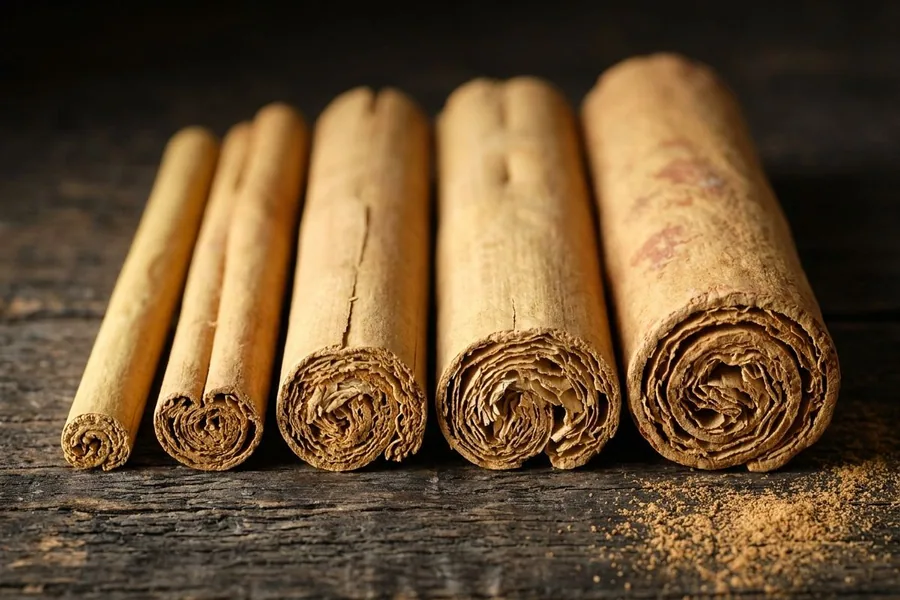
Look at the end of a stick. True Ceylon cinnamon is rolled from many thin layers of bark, so its cut end looks like a cut cigar; cassia is one thick layer curled into a hollow roll (BfR). Ceylon quills are light tan and crumble in the hand.
Ground cinnamon is hard to tell apart by eye (BfR), so ask the supplier for the botanical name and the origin, and test a sample. The guide to Ceylon vs cassia cinnamon sets out every difference, and the guide to how to verify true Ceylon cinnamon explains the checks.
How do I buy Ceylon cinnamon in bulk?
Harvest Gate is an agricultural exporter based in Colombo, Sri Lanka. It exports Ceylon cinnamon as quills and powder, alongside the other Sri Lankan spices in its range. Buying in bulk takes these steps:
- Send an enquiry: the form, quantity and destination port, through Request a Quote, by email or on WhatsApp.
- Receive a quotation for the consignment: product, form, grade, quantity, packing and destination, plus freight.
- Check samples before you order: request samples with your delivery address.
- Confirm the order: the consignment is packed for export in the packing agreed in the quotation.
- Documents: a phytosanitary certificate travels with every consignment, with the certificate of origin, packing list and commercial invoice your market requires.
- Shipping: by sea from the Port of Colombo or by air from Bandaranaike International Airport.
Buyer questions
Questions buyers ask about Ceylon cinnamon
What importers and food makers ask before buying true Ceylon cinnamon from Sri Lanka. Not answered here? Send the question with your sample request.
Request samples01What is Ceylon cinnamon vs cinnamon?
"Cinnamon" is a name for the bark of several related trees. Ceylon cinnamon comes from one of them, Cinnamomum verum, grown in Sri Lanka. In the EU, "Ceylon cinnamon" is a protected name for cinnamon from Sri Lanka. A pack labelled only "cinnamon" may hold cassia, a different species that is hard to tell apart once ground.
02Is Ceylon cinnamon the same as true cinnamon?
Yes. Ceylon cinnamon, true cinnamon and real cinnamon are all names for the bark of Cinnamomum verum, also listed as Cinnamomum zeylanicum. Cassia, the other bark sold as cinnamon, comes from related trees grown mainly in China, Indonesia and Vietnam.
03Which forms of Ceylon cinnamon does Harvest Gate export?
Harvest Gate exports Ceylon cinnamon as quills and powder. Quillings, chips and cinnamon oil are in its range too. The grade, form and packing of each order are set out in the quotation.
04Can I see samples before buying Ceylon cinnamon in bulk?
Yes. Request samples with your delivery address and the form you need, such as quills or powder, so you can check the cinnamon before your first order.
Sources
- DEA, the Department of Export Agriculture, Sri Lanka: Cinnamon.
- EDB, the Export Development Board of Sri Lanka:Ceylon Cinnamon geographical indication.
- European Union: Commission Implementing Regulation (EU) 2022/144, entering "Ceylon cinnamon" in the register of protected geographical indications.
- BfR, Germany's Federal Institute for Risk Assessment: FAQ on coumarin in cinnamon and other foods.
- IPS, the Institute of Policy Studies of Sri Lanka: Quality standards: make or break point of Sri Lanka's cinnamon industry (Daily Mirror, 14 May 2019).
Request samples
See true Ceylon cinnamon for yourself.
Tell us the form you need, such as quills or powder, and where to send the samples.